Author: Admin

  • How to Travel Without Low Back Pain

    The weekend road trip to Montreal seemed like such a great idea until 500km later when I stepped out of the car and found my entire low back in spasm. I almost couldn’t straighten up and was starting to walk with a limp.  Oh how I was almost tempted to go into some downward dog yoga poses right there in the parking lot in order to relieve the pain.  Luckily I didn’t have to resort to that.  Just walking it off a bit and moving around loosened it up.  But it did remind me of a common complaint from my clients and also a condition I lived with for a few years.  Most importantly, it inspired me to write a blog post to help out all those summer travelers.

    One big reason why people start to suffer from low back pain on long car rides is inactivity.  Our bodies are not meant to be immobile for hours on end.  Our muscles need to move about, contract and stretch in order to remain functional.  Inactivity decreases blood circulation, waste removal and nerve conduction to the muscles resulting in muscles that are irritated and sore.

    If immobility is the cause of pain, then surely some motion must be the cure.  From suffering years of low back pain, I developed these exercises that always did the trick for me on car or plane rides.  Try some of these on your next journey and you will see the improvement.

    Tips for Preventing Back Pain

    • Stop frequently.  You can take a breath of fresh air, enjoy the scenery, grab a snack, etc, etc.  But most importantly, you are stretching out those muscles and moving them in a natural fashion and boosting blood circulation.
    • Keep hydrated.
    • If you’re stuck in a car seat, wiggle a little.  Crank up the tunes and start jiggling!  It’s good for your health!  You might not be inspired enough to break out into a full blown fist pumping dance session, but some slow gentle motion can greatly help you stay loose. Here’s how:

    Mobilize Your Lower Back

    1. Start by raising your left hip then lower it.  Then raise your right hip then lower it.
    2. Then try twisting your left hip forward then back, followed by the right.
    3. Arch your lower back so that your bum sticks out a bit more.  Next round your lower back.

    Exercise Your Gluteal Muscles

    1. Now you can start working your gluteal muscles.  First of all, you want to squeeze both glutes together.  If you do this right you might feel yourself lift off the seat a bit.
    2. Next try squeezing just the left gluteal muscles.  It might help to push your left foot into the floor at the same time almost as if you are trying to raise that left hip off the seat.  Now try the right and alternate back and forth.
    3. If you are feeling especially adventurous, turn the volume up to 11 and just dance without any shame.

    Safety First

    1. A few things to remember for safety sake:  To avoid accidents it is not recommended to do these exercises if you are driving.  To avoid being locked up, try these moves by yourself first so that you feel comfortable enough doing them in a way that doesn’t attract too much attention in public (the key is slow, small movements).

    It might seem a bit strange at first, but with some practise it will become second nature on those long trips.  And by the way, I did these exercises on the ride back from Montreal and was amazed at how I felt no traces of back pain when I stepped out of the car in Toronto.

    If you find the pain too intense or long lasting, you might need a massage or acupuncture treatment.
  • Holiday Hours

    I will be taking Saturday July 31 to Monday August 3 as a holiday to rest up for a bit.  I look forward to seeing you next week Tuesday August 4.  Cheers.  Hope everyone has a wonderful weekend.

  • What is fascia?

    What is fascia?  If you’ve ever cooked chicken, you’ve probably noticed it. The thin, transparent, filmy material that covers the chicken meat.  Our muscles are covered in fascia.  Fascia covers every muscle and keeps the muscle together.  Fascia covers and protects every single muscle bundle or fascicle that makes up the muscle.  Fascia also covers every single muscle fibre or muscle cell that makes up the bundle,  It is like the framework or scaffolding that the muscle operates within.  Fascia holds and supports the muscle together giving it shape, form and function.  It also helps the muscles slide over each other with less friction.  The body is made up of over 600 muscles that layer over each other and criss cross each other.  Each muscle needs to slide over, under or beside its surrounding muscles without interference in order to function properly.

    Fascia has a few interesting properties too.

    • It is pound for pound stronger than steel.  In other words, unless you know how to treat it correctly it can and will be very difficult to get it to release.
    • Fascia is also the material that makes up tendons and ligaments.
    • It is not contractile.  That is, it doesn’t contract or relax the way a muscle does.
    • It can shrink or expand but we have little control over that.  It also seems to be emotional.  In times of emotional stress, fascia contracts and tightens around the muscle it is trying to protect.
    • When a muscle is hurt, as in a car accident or athletic injury, the muscle and fascia often tears.  This tear eventually heals the same way that a skin cut can heal.  However, the same way that the skin can be left with a thick, inflexible, sensitive scar, the muscle and fascia can also scar.

    The last point is why fascial work can be so important to healing sports injuries and traumatic injuries.  An inflexible scar in a muscle can do a few things:

    • It can remain short, tight and inflexible causing pain whenever the muscle tries to stretch to its full strength.  You might even notice a sharp almost tearing feeling when you try to stretch.
    • The scar can become adhesed or glued to the fascia of surrounding muscles.  This acts as a monkey wrench in the system.  None of the muscles that are adhesed can function pain free in their normal ranges with this.  For example, if a scar forms between your quads and your adductor/groin muscles you might notice that you don’t have the same strength or flexibility with either quad exercises or adductor exercises.  The reason is that those muscles are essentially glued together and pulling on each other each time you use them.

    So now we know that fascia is everywhere; it’s stronger than steel; it can scar; it can become glued to other muscles.  And for many people, it is the key to solving chronic pain from old injuries. I’ll have posts in the future about how I can treat fascial restricitons with active fascial release, rolfing, myofascial release technique and acupuncture.

  • Massage Therapy and the HST

    There are plans to harmonize Ontario’s retail sales tax with the federal Goods and Services Tax (GST).  This means that the new 13% harmonized tax will apply to massage therapy as well.

    Here is an excerpt from the Ontario Massage Therapist Association (OMTA).

    Harm to Patients

    Massage therapy is not covered by the Ontario Health Insurance Plan (OHIP), instead, these services are paid directly by patients, either out-of-pocket or through their extended health benefit programs. The introduction of HST will mean that:

    • By adding the 8% tax, given that massage therapy is already taxed under the federal Goods and Services Tax, Ontarians will be paying more for health care services, either from their own income or through their extended health benefit plan;
    • With less funding available, patients will be forced to reduce the frequency with which they seek treatment, both for injuries and on-going preventive health care, or eliminate these services entirely;
    • This reduction in services will cause a direct impact on the health and well-being of many Ontarians and, in the long term, will affect Government spending in other areas of health care.

    Harm to RMTs

    The reduction in the funds patients have available, either individually or through an extended health benefit plan, will result in a reduction in services sought by Ontarians.  The profession is already facing significant economic distress.  The introduction of the HST will mean that:

    • RMTs will face increased economic difficulties operating their practices as the available funding for massage therapy is reduced and therefore patients seek fewer or no services;
    • The economic downturn, coupled with the recently announced increase in annual registration fees from the College of Massage Therapists of Ontario, an increase that is necessary in order to sustain the self-regulatory model, will only serve to make matters worse for many RMTs;

    The inability of the profession to sustain itself will result in fewer massage therapists and an inability of the profession to maintain the regulatory structures.

    You can take action by downloading this letter and mailing it to your MPP.  Or you can go to the OMTA website and fill out an online form that will automatically email it to Provincial parliament

  • The cost of Health Care

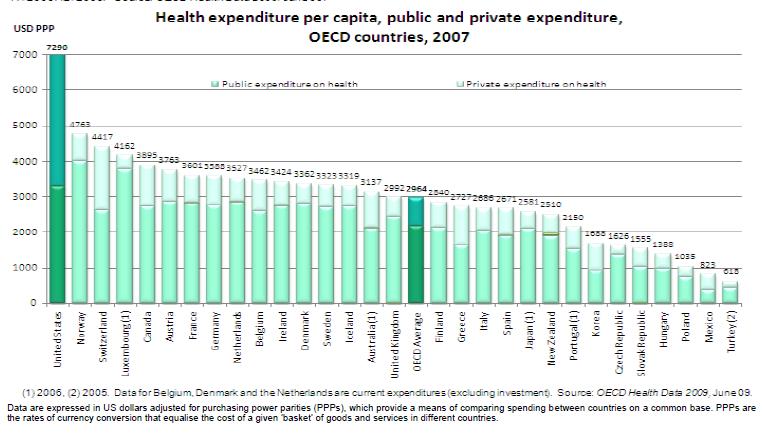
    The Organisation for Economic and Co-operation and Development (OECD) released the report “OECD Health Data 2009” which compares the health care statistics across OECD countries.

    Surprisingly, the American system of health care is the most expensive in the world in terms of public spending per capita, private spending per capita, and total cost per capita (roughly double the OECD average).

    Canada is more in line with the pack, but still at the higher end.

    Cost of Health Care
    Cost of Health Care
  • What does it feel like to have a stroke?

    This is a fascinating firsthand recount of experiencing a stroke by a neuroscientist. It is a part of the TED series of talks.